About Ollie Thorne
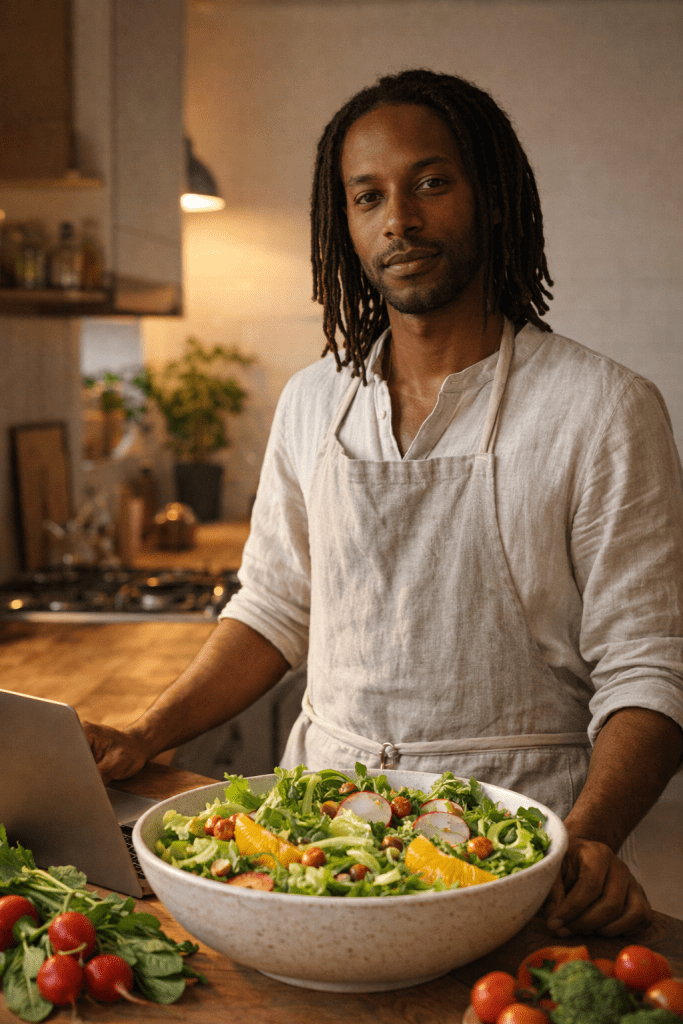
If you’ve ever wondered what would happen if you left a software engineer alone in a kitchen with a soldering iron, a sourdough starter, and an unreasonable number of spreadsheets, you’ve essentially found the answer.
I’m Ollie Thorne. By day, I architect systems, write code, and think in abstractions. By night, I caramelize onions slowly enough to contemplate the ethics of global supply chains. Somewhere between those two worlds, this blog was born.
I’ve always believed that food is infrastructure.
Not metaphorically—literally. It’s a system of inputs and outputs, supply chains and feedback loops, optimization problems and ethical trade-offs. What we grow, how we transport it, what we waste, what we valorize—these are design decisions. And like any design decision, they shape the world we inhabit.
My childhood was filled with the scent of slow-cooked stews and the hum of early desktop computers. I learned to write my first lines of code around the same time I learned that you never throw away vegetable scraps—they become stock. Both lessons stuck. One taught me about logic; the other taught me about care.
Why Food + Tech?
Because the future of food won’t be shaped by nostalgia alone.
We’re staring down climate instability, soil degradation, fragile logistics networks, and a cultural obsession with convenience that too often sidelines sustainability. At the same time, we have machine learning models predicting crop yields, precision fermentation creating proteins without livestock, 3D printers piping edible pastes into intricate geometries, and sensor-rich greenhouses that feel more like spacecraft than farms.
That intersection fascinates me.
I’m curious about what happens when:
- We treat recipes like algorithms.
- We analyze food waste like technical debt.
- We design kitchens the way we design distributed systems.
- We ask not just can we automate something—but should we?
Technology is a tool. Ethics is the compass. Cuisine is the terrain where they meet.
My Philosophy in the Kitchen
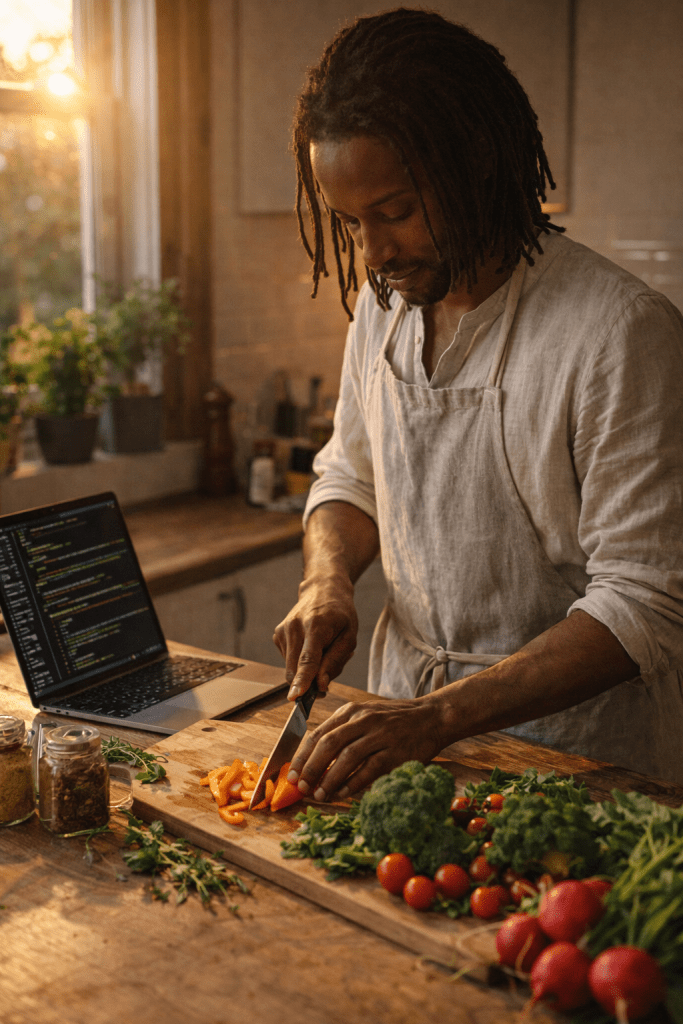
I cook the way I code: iteratively.
I taste, adjust, refactor. I break down a dish into its primitives—acid, fat, heat, salt—like functions in a clean architecture. I question assumptions. I measure. Sometimes I over-engineer. Sometimes I burn things and call it “experimental char development.”
Above all, I minimize waste.
Vegetable peels become crisps. Herb stems become pesto. Stale bread becomes pangrattato. Bones become broth. If an ingredient required land, water, labor, and transport to reach my kitchen, it deserves respect.
Local sourcing matters to me not as an aesthetic choice, but as a systems decision. Shorter supply chains mean fewer failure points, lower emissions, stronger communities. When I buy from nearby growers, I’m not just purchasing food—I’m reinforcing a network.
And yes, I compost. Religiously.
What You’ll Find Here
This blog is where I explore:
- The chemistry of fermentation and the poetry of sourdough.
- The mathematics of spice blending.
- The ethics of lab-grown meat.
- The promise (and limitations) of 3D-printed food.
- How AI might reduce household food waste.
- Why “zero waste” is less about perfection and more about intention.
You’ll find deep dives into technical concepts explained through the lens of cooking. You’ll find recipes that respect ingredients. You’ll find the occasional code snippet wrapped in a culinary metaphor.
You’ll also find stories—because food is never just technical.
It’s memory. It’s culture. It’s belonging.
I once spent an entire weekend building a small sensor array to monitor the humidity in my fermentation chamber, only to realize that my grandmother had been achieving better results for decades with nothing more than intuition and a tea towel. That humbling contrast stays with me. Technology can augment wisdom—but it shouldn’t replace it blindly.
Sustainability Without Sanctimony
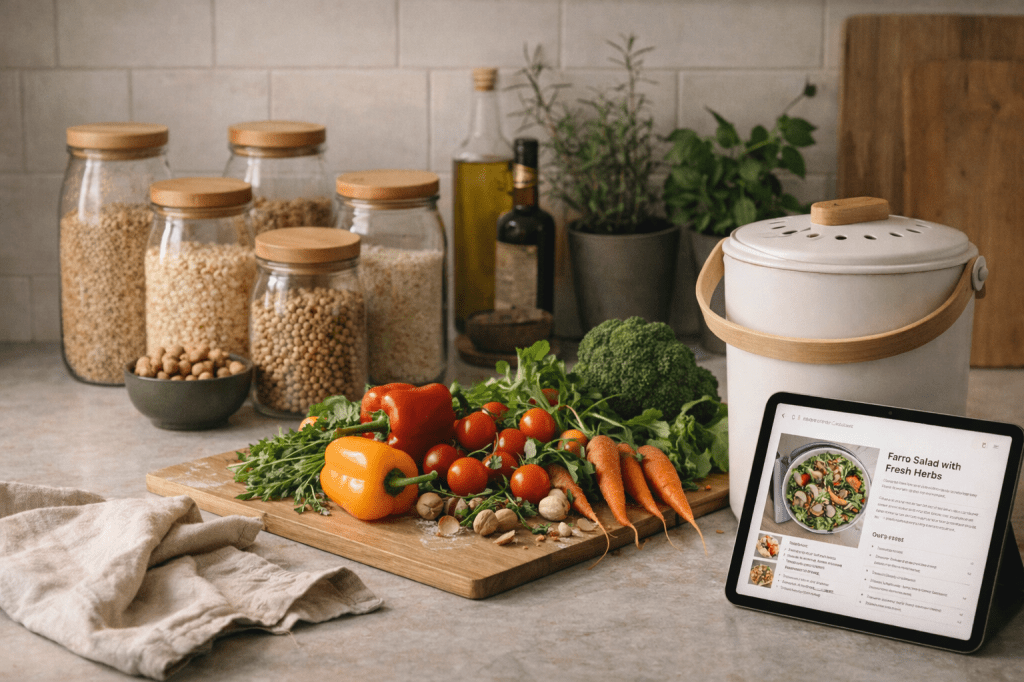
I don’t believe sustainable eating has to be joyless.
You can care about carbon footprints and still obsess over the perfect crust on a loaf of bread. You can discuss agricultural policy while simmering a rich tomato sauce. You can be rigorous and playful at the same time.
Food systems are complex, messy, and deeply human. There are no clean commits here—only continuous integration. We iterate toward better.
If I have a mission, it’s this: to make sustainability practical, intellectually engaging, and delicious.
To treat the kitchen as both laboratory and sanctuary.
To question trends without dismissing innovation.
To explore how robotics, machine learning, and bioengineering might reshape our plates—and to ask what kind of future we’re cooking up in the process.
A Bit More Personal
I’m a lean Black English man with dreadlocks who looks equally at home behind a keyboard or behind a stove. I love long walks through farmers’ markets. I get irrationally excited about heirloom varieties of anything. I believe good knives change lives.
If you come here expecting tidy answers, you won’t always find them. What you will find is curiosity. Care. A willingness to experiment.
And perhaps a gentle nudge to look at your next meal—not just as sustenance, but as a system.
Thanks for being here.
Let’s build a better food future—one line of code, one simmering pot, one thoughtfully sourced ingredient at a time.
 Bites & Bytes