
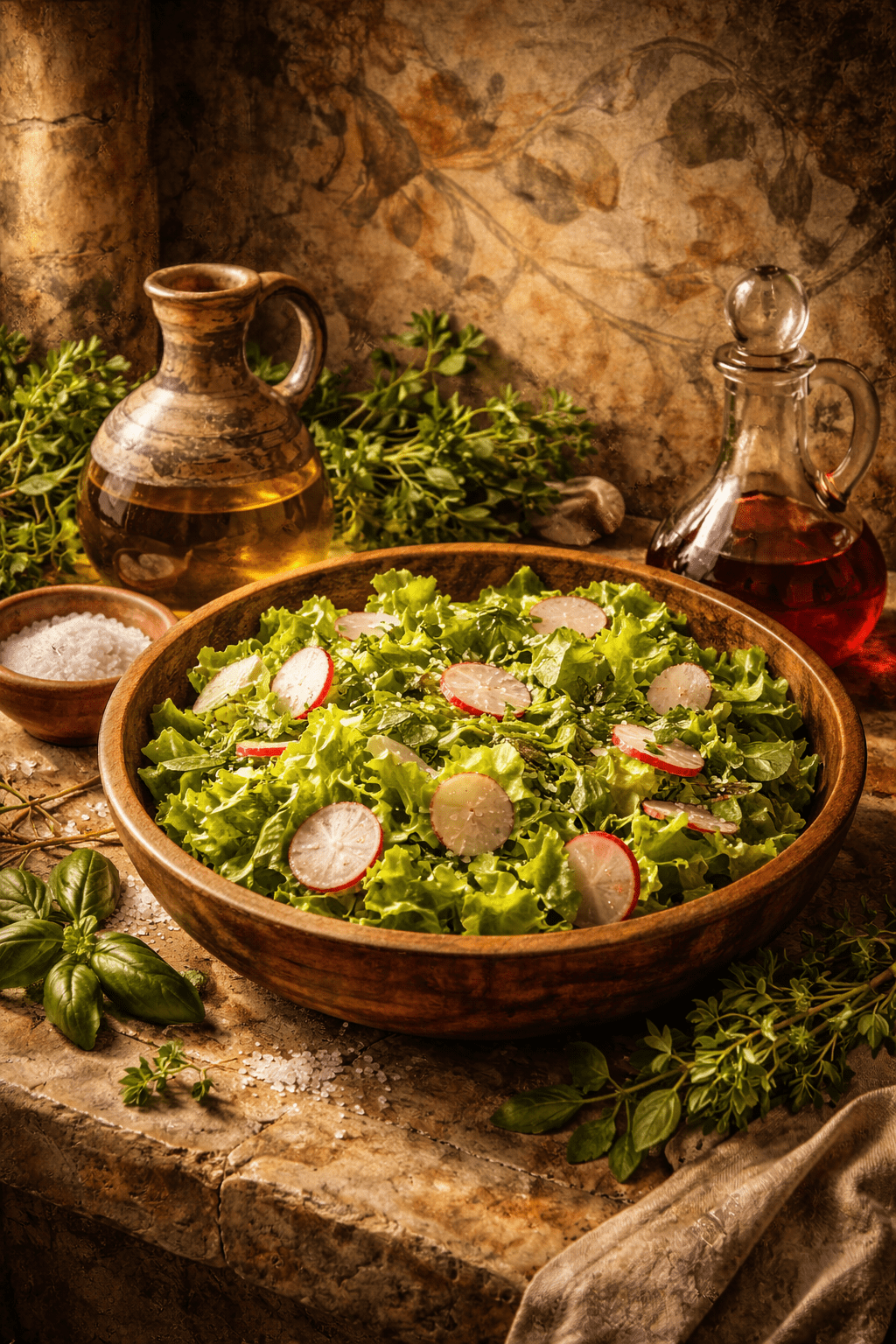
There is something quietly radical about a salad.
Not the towering, overdressed monument that arrives at certain restaurants like a botanical spectacle, but the simple act of gathering leaves, herbs, perhaps a shard of cheese, a thread of oil, and calling it a meal. Salad feels modern—clean, virtuous, quick. And yet, it is among the oldest expressions of cooking we possess, older even than the hearth-bound stews that simmered in the clay pots of antiquity.
Long before fire domesticated our dinners, we were eaters of leaves.
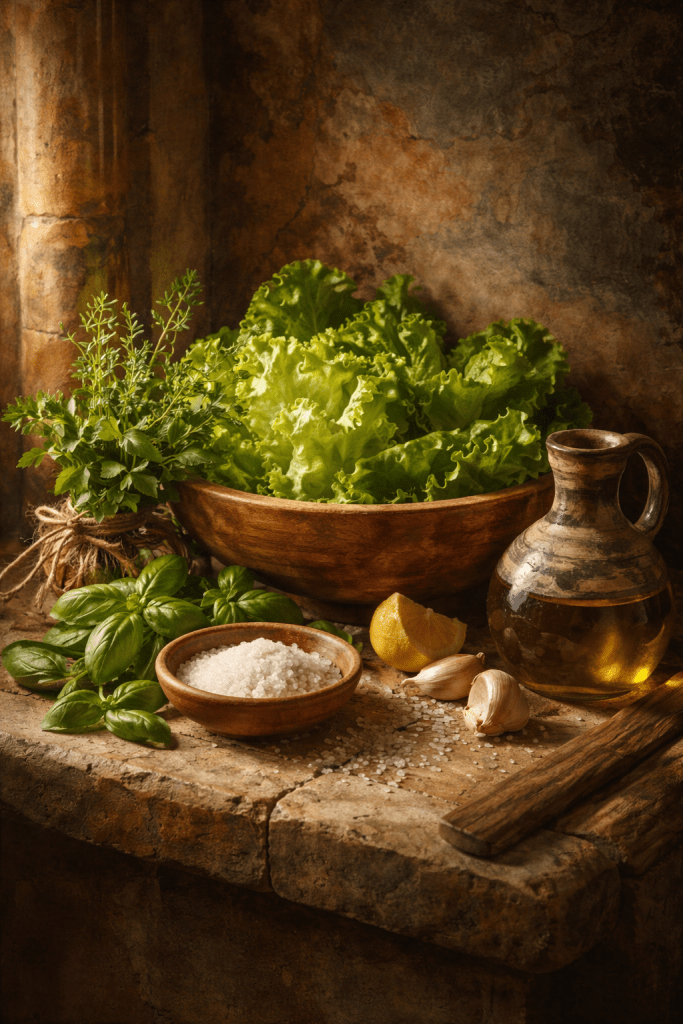
The word itself—salad—whispers its ancestry. It descends from the Latin sal, meaning salt. The Romans prepared herba salata: salted herbs and greens dressed with brine or garum, their pungent fermented fish sauce. In the villas of the Roman elite, lettuce was often served at the end of a meal, not the beginning, believed to induce sleep. Imagine reclining after a banquet, heavy with roast dormice and honeyed figs, finishing with crisp leaves glossed in oil and salt—a gentle coda to indulgence.
The Romans were not alone in their affection for dressed greens. In ancient Persia, fresh herbs were arranged in abundance as part of the meal itself, a custom that endures in the sabzi platters of today. Medieval Europeans, too, prized raw herbs, though they treated them with caution. In the 12th century, Hildegard of Bingen warned that some raw vegetables were “of a cold nature,” capable of unsettling the humors if not properly balanced with vinegar and salt. Even then, salad was less an afterthought than a matter of philosophy and physiology.
I once stood in the ruins of Pompeii, staring at a faded fresco of a fruit bowl, and was struck by how little we have changed. We still crave freshness, color, the vitality of uncooked plants. The difference is not in the instinct, but in the abundance.
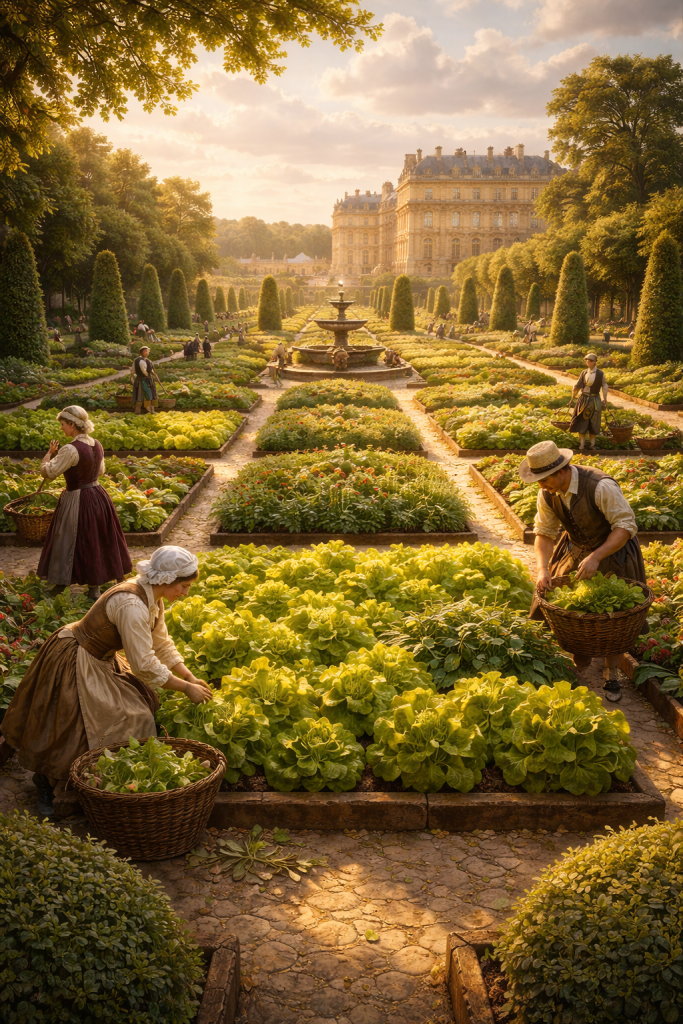
By the Renaissance, salads had evolved into elaborate compositions. In 16th-century Italy, Platina wrote of mixing herbs with oil and vinegar, cautioning against over-salting. In France, the 17th century saw the codification of vinaigrette—three parts oil to one part vinegar, though any good cook knows ratios are guides, not commandments. The court of Louis XIV was particularly fond of lettuce; the king’s gardeners cultivated dozens of varieties in Versailles’ potagers, ensuring year-round supply. To eat salad at court was to partake in horticultural innovation and political theater.
Salad is often dismissed as “just vegetables,” but that phrase ignores its revolutionary nature. For much of human history, raw produce was seasonal, perishable, and suspect. The ability to eat salad year-round signals refrigeration, global trade, and agricultural engineering. When we toss arugula with citrus in January, we are beneficiaries of centuries of botanical experimentation and maritime ambition.
And yet, salad is also deeply local. Consider the Greek horiatiki—tomatoes, cucumbers, olives, feta—impossible before the Columbian Exchange delivered tomatoes from the Americas to Europe. Or the Caesar salad, born not in Rome but in Tijuana in the 1920s, when restaurateur Caesar Cardini improvised with romaine, egg, Parmesan, Worcestershire sauce, and theatrical flair. The anchovy-laced dressing, emulsified tableside, is less a relic of antiquity than a testament to 20th-century cosmopolitanism.
There is something else about salad that fascinates me. It is one of the few dishes where restraint is the highest virtue. A stew forgives excess; a sauce can conceal imbalance. But a salad is merciless. Too much dressing and the leaves collapse. Too little salt and the flavors retreat into greenness. The cook must taste, adjust, taste again. It is a conversation between acid and fat, crunch and tenderness.
When I teach students about culinary history, I often begin with salad. It disarms them. They expect grand narratives of spice routes and royal banquets, not a bowl of leaves. But therein lies the lesson: civilization is not only built on feasts. It is built on the quiet, repeated act of seasoning what grows at our feet.
Herba Salata Reimagined: Butter Lettuce Salad with Dijon Vinaigrette, Herbs, and Shaved Radish
Ingredients
For the salad:
- 2 heads butter lettuce (or tender leaf lettuce), leaves gently separated, washed, and thoroughly dried
- 4–5 small radishes, paper-thin slices
- 2 tablespoons finely chopped fresh chives
- 2 tablespoons flat-leaf parsley leaves
- A small handful of fresh dill fronds
- 2 ounces aged Parmesan or Pecorino, shaved into thin shards
- Flaky sea salt
For the vinaigrette:
- 1 tablespoon Dijon mustard
- 1 tablespoon red wine vinegar
- ½ teaspoon raw honey
- 3 tablespoons extra-virgin olive oil
- Freshly ground black pepper
- A small pinch of fine sea salt
Instructions
Begin, as all good salads demand, with dryness. After washing the lettuce, spin or pat the leaves until no trace of water clings to their surfaces. Moisture will dilute the vinaigrette and prevent it from embracing the leaves properly—a small but decisive detail.
In a small bowl, whisk together the Dijon mustard, red wine vinegar, honey, and a pinch of salt. Slowly drizzle in the olive oil while whisking continuously. The mixture will thicken and turn glossy as it emulsifies. Finish with several turns of black pepper. Taste. It should be bright but rounded, assertive but not sharp. Adjust with a drop more vinegar or oil as needed.
In a large wooden bowl, tear the butter lettuce into generous pieces—never cut, as a blade bruises the leaves and hastens their decline. Scatter in the sliced radishes, chives, parsley, and dill.
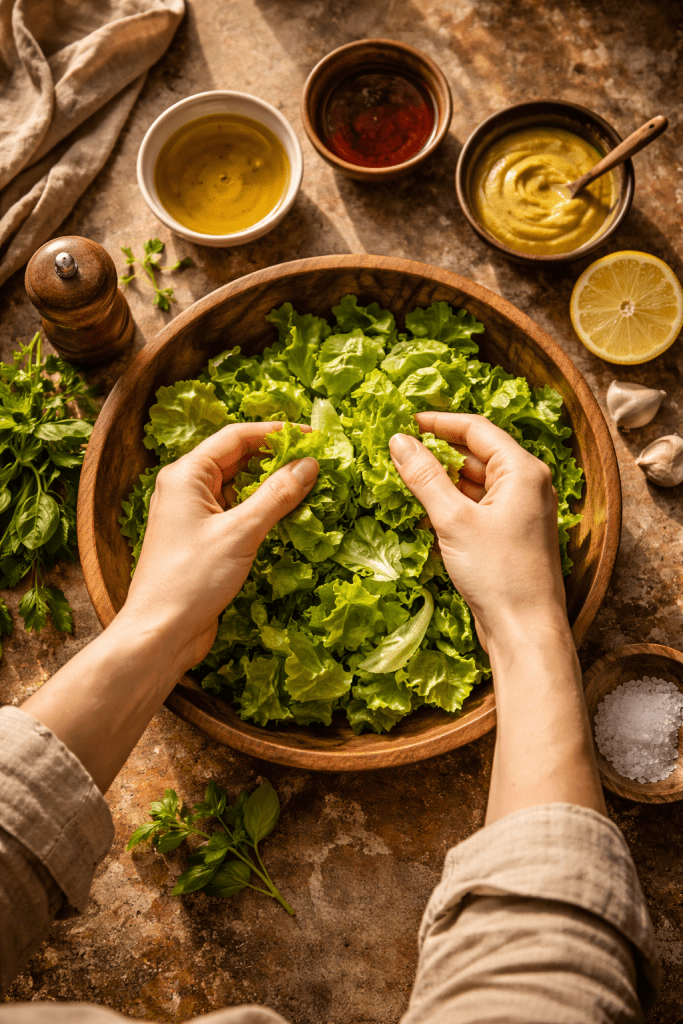
Drizzle just enough vinaigrette over the leaves to lightly coat them. Toss gently with your hands, lifting from the bottom so the dressing distributes without crushing the greens. Add a small pinch of flaky sea salt and toss once more.
Transfer to a wide serving dish. Shower the top with shaved cheese so that it rests lightly, not buried. Serve immediately—salad waits for no one.
And as the fork gathers leaf, herb, and glistening vinaigrette into one harmonious bite, we return—quietly, almost reverently—to the ancient wisdom of salted greens.
There is an intimacy to preparing salad that I cherish. Washing each leaf, spinning it dry—water is the enemy of adherence, and dressing must cling, not pool. Tearing, never cutting, to avoid bruising. Whisking oil into vinegar until they suspend their natural antagonism and become, briefly, one.
In our era of engineered snacks and shelf-stable abundance, salad feels like a corrective. It insists on immediacy. Leaves wilt. Herbs fade. A dressed salad waits for no one. It must be eaten now, in the bright moment of its assembly.
Perhaps that is why salad persists. It reminds us that freshness is fleeting, that balance is deliberate, that even the simplest dish carries the weight of history. From Roman salted herbs to Versailles gardens to the neighborhood farmers’ market, the salad bowl has always been a site of exchange—between cultures, between seasons, between the raw and the refined.
So the next time you lift a forkful of glistening greens, pause. Consider the salt—once precious enough to pay soldiers. Consider the oil—pressed from olives cultivated over millennia. Consider the vinegar—born of fermentation, that most ancient transformation. You are not merely eating leaves. You are tasting empire, agriculture, trade, science, and restraint.
And in that crisp bite, you may just hear the faint echo of herba salata, still whispering across the centuries.

 Bites & Bytes
Leave a comment