
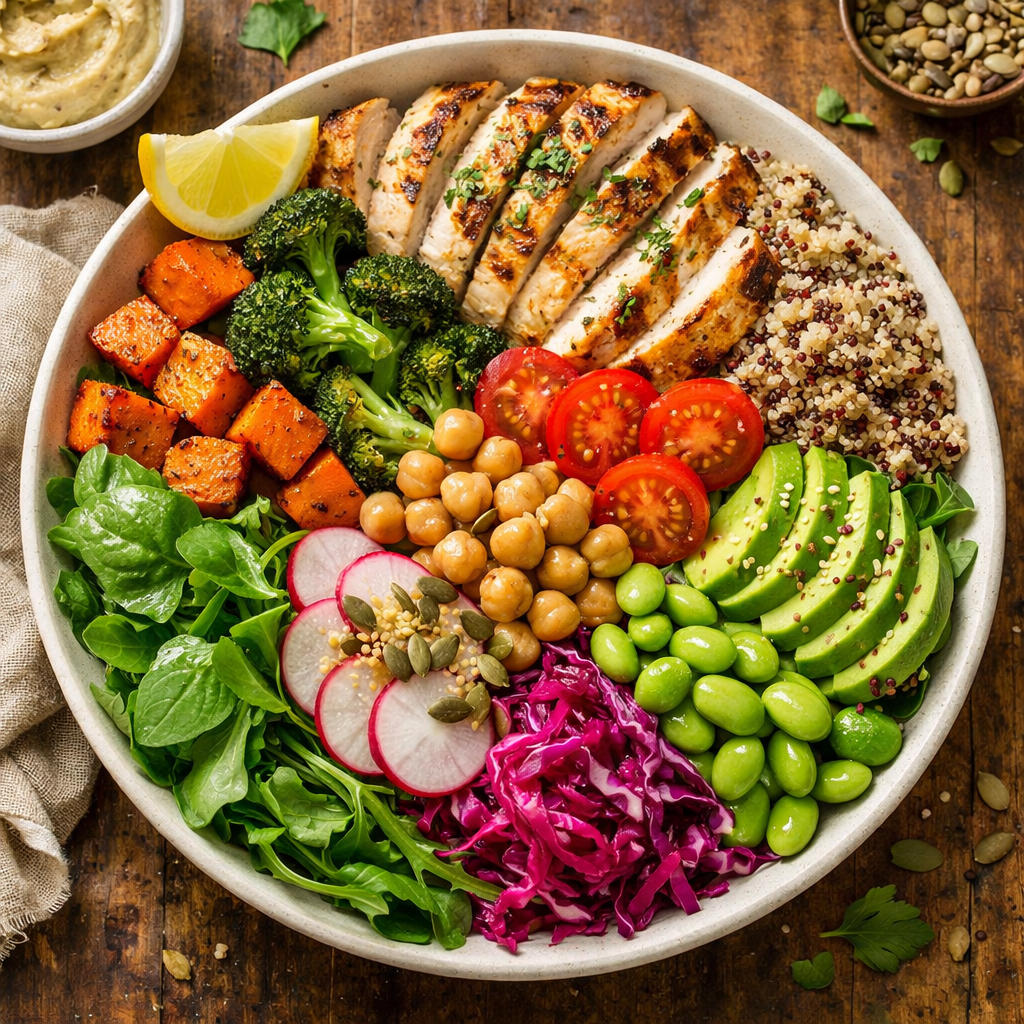
When most people hear “salad,” they picture one of two things:
- A sad bowl of lettuce and regret.
- A giant calorie bomb drowning in sugary dressing.
Neither one excites me.
As a strength coach and sports nutrition nerd, I see salad differently.
A well-built salad is one of the most powerful performance meals you can eat. It can deliver protein, fiber, micronutrients, phytonutrients, complex carbs, and healthy fats — all in one bowl.
But here’s the key:
Salad is not about eating less.
It’s about building smarter.
And once you understand how to construct one properly, it becomes one of the most versatile tools in your nutrition strategy.
Train
Let’s talk physiology first — because the gym drives the kitchen.
If you strength train with intent — progressive overload, full range of motion, structured volume — you create a demand:
- Muscle repair
- Glycogen replenishment
- Inflammation management
- Micronutrient utilization
- Hormonal recovery
Your meals should answer that demand.
And here’s what most “diet salads” fail to do:
They’re too low in protein.
Too low in total calories.
Too low in carbohydrates.
Too low in sodium (which active lifters actually need).
So people eat them, feel virtuous for 45 minutes, then end up raiding the pantry.
That’s not lack of willpower. That’s under-fueling.
I remember early in my career packing what I thought was a “clean” lunch: spinach, cucumbers, grilled chicken breast — no carbs, minimal fat.
By 3 p.m., I was irritable and fantasizing about sourdough bread.
Now? My salads are engineered for performance.
The 5-Layer Performance Salad Framework
When I coach clients who train 3–5 days per week, I give them this structure:
1. Protein Anchor (30–50g)
Grilled chicken thighs, steak, salmon, shrimp, tofu, tempeh, lentils + yogurt dressing.
This supports muscle protein synthesis. Aim to cross the leucine threshold (~2–3g leucine per meal), which usually means 30+ grams of high-quality protein.
2. Carb Base (40–80g depending on training load)
Quinoa, roasted sweet potatoes, farro, chickpeas, black beans, wild rice.
Carbs replenish glycogen. Glycogen fuels heavy lifting. Heavy lifting builds muscle. This is a loop — not a moral debate.
3. Leafy Greens & Volume
Spinach, arugula, romaine, kale.
This is where we layer fiber, potassium, magnesium, folate, and phytochemicals. Think of greens as metabolic support, not the main event.
4. Color & Texture
Roasted peppers, shredded carrots, cabbage, beets, radishes, herbs.
Color diversity often correlates with antioxidant diversity. Plus — crunch matters. Texture drives satisfaction.
5. Strategic Fats (10–20g)
Olive oil, avocado, tahini, nuts, seeds.
Fats support hormone production and improve absorption of fat-soluble vitamins (A, D, E, K). But we use them intentionally — not accidentally.
When you hit all five layers, salad stops being diet food and becomes recovery food.
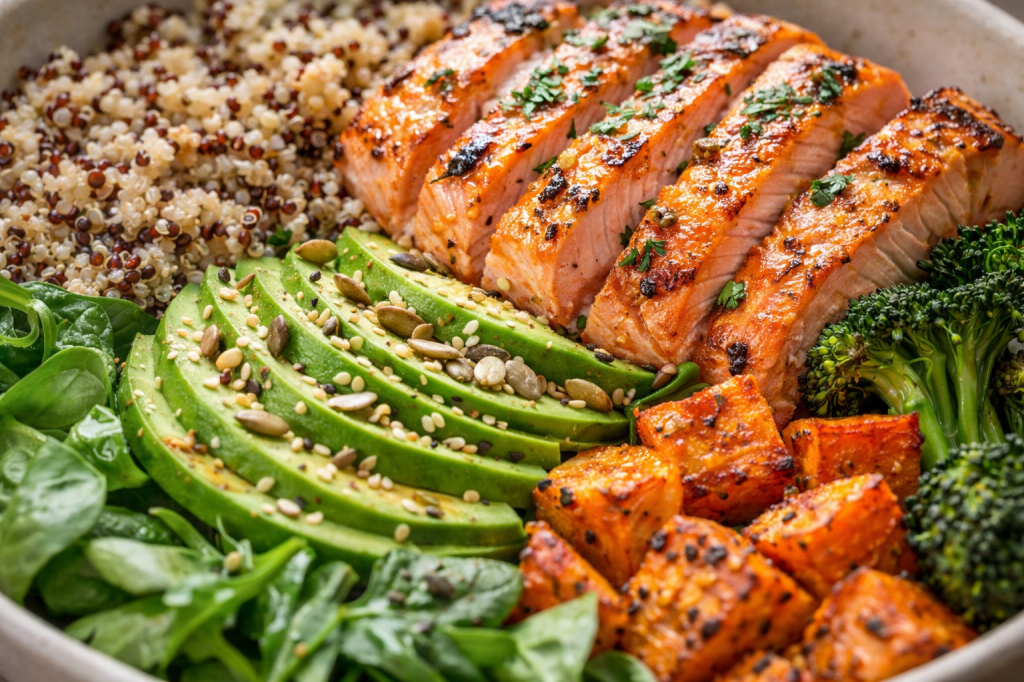
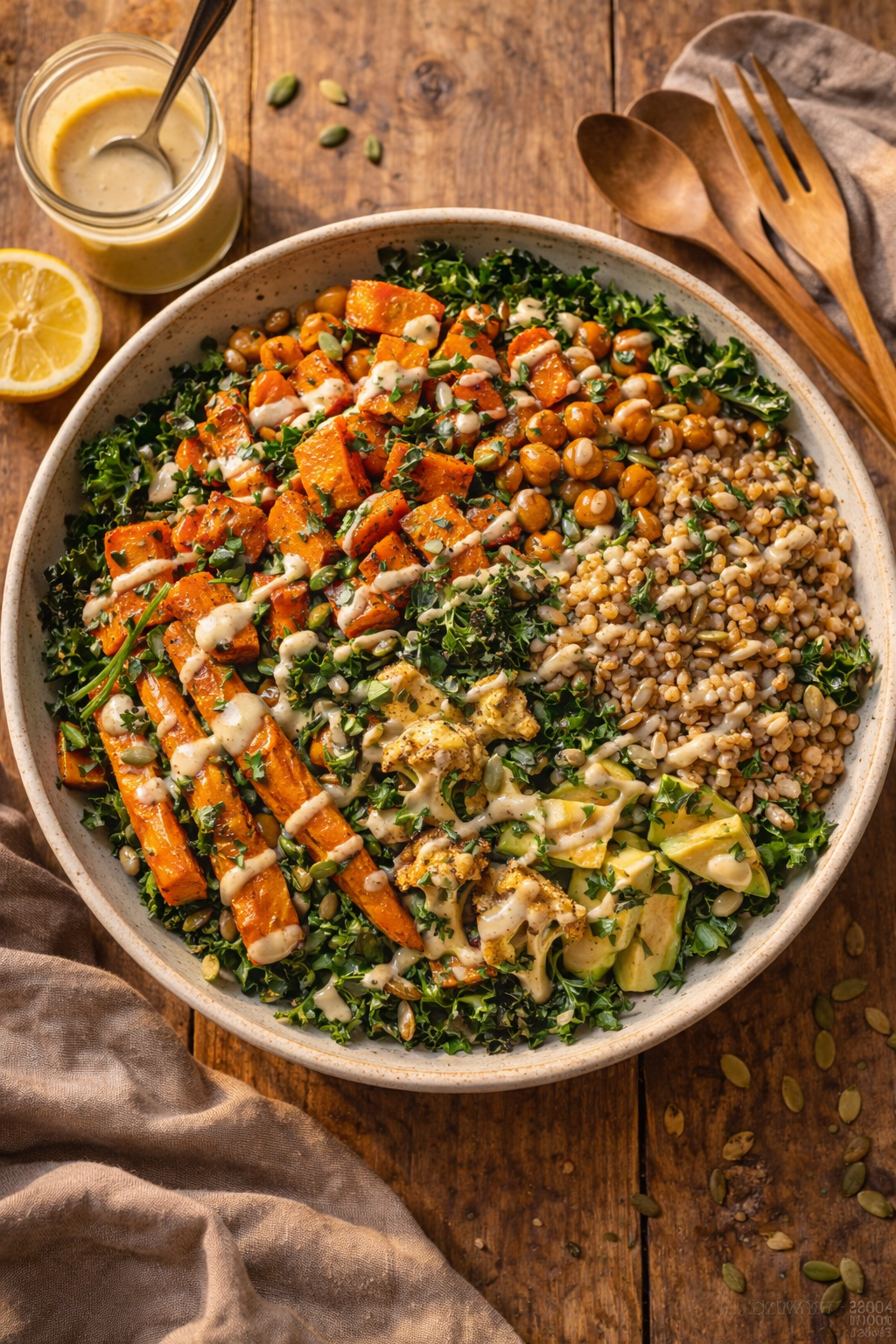
Roasted Salmon & Sweet Potato Performance Salad
Serves: 4
Prep time: 20 minutes
Cook time: 25–30 minutesIngredients
For the salmon
- 4 salmon fillets (5–6 oz each)
- 1 tablespoon olive oil
- 1 teaspoon Dijon mustard
- 1 teaspoon smoked paprika
- ½ teaspoon garlic powder
- ½ teaspoon sea salt
- Fresh black pepper
- Juice of ½ lemon
For the roasted sweet potatoes
- 2 medium sweet potatoes, cubed
- 1 tablespoon olive oil
- ½ teaspoon sea salt
- ½ teaspoon cinnamon
- ¼ teaspoon chili flakes (optional)
For the quinoa
- ¾ cup dry quinoa, rinsed
- 1½ cups water or low-sodium broth
- Pinch of salt
For the salad base
- 4–5 cups baby arugula
- 3 cups baby spinach
- 1 cup shredded red cabbage
- 1 red bell pepper, sliced
- 1 large carrot, shredded
- 1 avocado, sliced
For the lemon-tahini yogurt dressing
- ½ cup plain Greek yogurt (2% or full-fat)
- 1 tablespoon tahini
- 1 tablespoon olive oil
- Juice of 1 lemon
- 1 small garlic clove, grated
- 1–2 tablespoons warm water (to thin)
- Salt to taste
Optional toppings
- Pumpkin seeds or toasted almonds
- Fresh parsley or dill
- Extra squeeze of lemon
Instructions
- Roast the sweet potatoes.
Preheat oven to 425°F (220°C). Toss sweet potato cubes with olive oil, salt, cinnamon, and chili flakes. Spread evenly on a lined baking sheet. Roast 25–30 minutes, flipping halfway, until caramelized and tender.- Cook the quinoa.
In a saucepan, combine quinoa, water, and salt. Bring to a boil, then reduce to low, cover, and simmer 12–15 minutes until liquid is absorbed. Remove from heat and let sit covered 5 minutes. Fluff with a fork.- Prepare the salmon.
Pat salmon dry. Mix olive oil, Dijon, paprika, garlic powder, salt, pepper, and lemon juice. Brush over salmon.
Bake at 400°F (200°C) for 12–15 minutes, or until it flakes easily and reaches 125–130°F for medium. Let rest a few minutes.- Make the dressing.
Whisk Greek yogurt, tahini, olive oil, lemon juice, garlic, and salt. Add warm water gradually until smooth and pourable.- Assemble the salad.
Divide arugula and spinach among bowls. Add quinoa, roasted sweet potatoes, cabbage, bell pepper, carrot, and avocado.
Top each bowl with a salmon fillet. Drizzle generously with dressing. Finish with seeds, herbs, and an extra pinch of sea salt if desired.Approximate Macros (per serving)
- Calories: 700–750
- Protein: 40–45g
- Carbohydrates: 70–80g
- Fat: 30–35g
- Fiber: 12–15g
Performance Notes
- ~40g protein supports muscle protein synthesis post-training.
- Sweet potatoes + quinoa replenish glycogen for recovery and next-session performance.
- Salmon provides omega-3s, which may help manage training-induced inflammation.
- The fiber content supports blood sugar stability and satiety.
Big. Balanced. Built to recover from real training.
Fuel
Now let’s zoom in on why salad can be metabolically powerful — especially for strength-focused athletes.
1. Fiber Improves Nutrient Partitioning
High-fiber meals improve satiety and glycemic control. When blood sugar regulation improves, so does energy stability.
For lifters, that means:
- Fewer crashes
- More consistent training performance
- Better appetite regulation
Most active adults should aim for 25–38g of fiber daily. A well-built salad can contribute 10–15g in one meal.
That’s not about shrinking. That’s about stability.
2. Micronutrients Drive Recovery
You can hit your macros perfectly and still underperform if you’re deficient in magnesium, potassium, or iron.
Leafy greens and colorful vegetables deliver:
- Magnesium (muscle contraction & relaxation)
- Potassium (fluid balance & nerve signaling)
- Vitamin C (collagen synthesis & immune function)
- Folate (cell turnover)
When you’re training intensely, your micronutrient demand increases.
Salad is one of the most efficient delivery systems we have.
3. Volume Without Deprivation
One of my favorite things about performance salads is psychological.
They’re big. They’re satisfying. They feel abundant.
When someone transitions from restrictive dieting to strength-focused fueling, they’re often afraid of increasing calories.
A properly constructed salad allows us to increase:
- Protein
- Fiber
- Micronutrients
- Total calories (strategically)
Without feeling out of control.
Abundance changes mindset.
My Go-To Post-Lift Salad Strategy
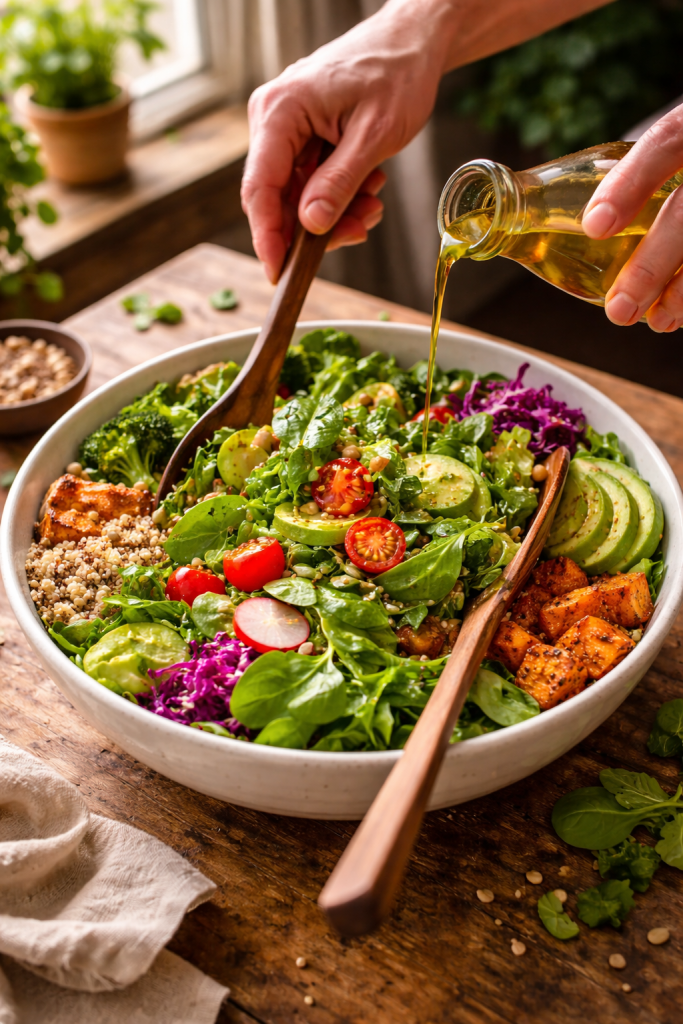
On heavy lower body days, my salad looks like this:
- 5–6 oz grilled salmon
- 1 cup roasted sweet potatoes
- ½ cup quinoa
- Large base of arugula + spinach
- Roasted red peppers + shredded cabbage
- Avocado slices
- Lemon-tahini Greek yogurt dressing
- Generous pinch of sea salt
Estimated macros:
- ~650–750 calories
- 40–45g protein
- 70–85g carbs
- 25–30g fat
- 12–15g fiber
And here’s what I notice:
- My legs recover faster.
- My next session feels stronger.
- My evening cravings disappear.
That’s not magic. That’s adequate fueling.
The Biggest Salad Mistakes I See
Let’s coach this up.
Mistake 1: Protein Sprinkles
Three ounces of chicken is not a protein-focused meal for an active adult. Be generous.
Mistake 2: Fear of Carbs
If you train hard, your body prefers glycogen. Ignoring that doesn’t make you disciplined — it makes you underpowered.
Mistake 3: Bottled Sugar Bomb Dressings
Many commercial dressings are mostly soybean oil and added sugar. Make your own with olive oil, yogurt, tahini, mustard, citrus, herbs.
Mistake 4: No Salt
If you sweat, you lose sodium. A properly salted meal improves satisfaction and hydration status.
The Long Game Perspective
Salad isn’t about shrinking your body.
It’s about supporting it.
When you train with progressive overload and fuel with meals built around protein, carbs, fiber, and micronutrients, your metabolism adapts upward.
You build muscle.
You improve insulin sensitivity.
You stabilize appetite.
And yes — body composition often improves as a byproduct.
But the primary goal is capability.
So Here’s My Challenge
Stop ordering side salads.
Start building performance bowls.
Think like an athlete — even if you’re just training three days a week around work and family.
Build the protein anchor.
Add the carb base.
Layer color.
Finish with intentional fats.
Salad isn’t diet food.
It’s one of the most intelligent recovery tools you have — if you build it like you mean it.
Now go lift something heavy.
Then build a bowl worthy of the work.
 Bites & Bytes
Leave a comment